Martha+Tom

Spool knitting, learning on the job

One of the great things about where I work is that I often have the pleasure of observing workshops as the classroom space is very close to my desk area. Right now there is a knitting-focused exhibit on view for another month or so, so naturally workshops have focused on knitting as well! I was responsible for taking photos during the adult workshops, and I’d like to post those separately. This weekend was the last day of the ongoing children’s workshop on the many ways of knitting without needles. Having been curious about it for a long time, I finally asked the instructors to teach me to spool knit.

Here is my creation. So far I have made two like this and a third which is considerably longer.

Spool knit necklace

3 comments

Lamb Liver and Pork Terrine

Ever since I found Terrines, Pâtés, and Galantines in an antique store in Red Wing, I have been itching to make a terrine. But for whatever reason, I could never muster up the enthusiasm to assemble the various meat products required to make what the book describes as “the apotheosis of meatloaf”. It was the delicious duck terrine at the Red Stag Supper Club that finally convinced me to stop just talking terrine and start terrining terrine. Terrine.

Browsing the recipe section of T,P&G I found a recipe that was simple and rustic, two words that I like. The ingredient list for “Liver Terrine” was short:

  • 1# chicken livers
  • 1# pork
  • 1 small shallot
  • 2 T parsley, chopped
  • 2 1/4 t salt
  • 2 t pepper
  • 3/4 t ground ginger
  • 1/4 t ground cinnamon
  • 3 T brandy
  • 6 slices bacon

You begin to see what they mean by “apotheosis of meatloaf”! I didn’t have brandy on hand, so I planned to substitute bourbon, which I like better anyway. When I got to the butcher’s counter, I ran into a more serious deficiency: no chicken livers. Normally, the Wedge has a nice little bucket of the livers but, today being Valentine’s day (I guess?), they were out. My cashier suggested people might be buying Valentine’s for their cats. Luckily, the butcher was able to suggest an acceptable substitute:

Fava beans anyone?

As it happens, lamb liver is delicious, perhaps even more so than chicken livers. It has almost a piney taste, but in a good way. Of course, I didn’t know this yet, so I just went ahead with terrine assembly hoping for the best. Terrines are very easy, especially if you have a food processor. First I diced the liver:

Bloody good liver

Then I gave it a few pulses to catch it up to the already-ground pork, which I added and pulsed a bit to mix and grind further. The texture of a terrine can vary, from huge chunks of meat to a smooth paste. Since I was going for a rustic touch I left everything pretty coarse. After grinding the meat I mixed it with the rest of the ingredients, except for the bacon. The bacon is used to make a delicious little trough:

Everybody's getting really sick of bacon

To which the meat mixture is added. I covered it and put it into a 350° oven for a couple of hours, until the juices ran clear and the internal temperature is at least 160°. After the terrine cooled I weighted it (for proper shape and texture) and put it in the refrigerator overnight. The next day, we had terrine bliss:

Looking good

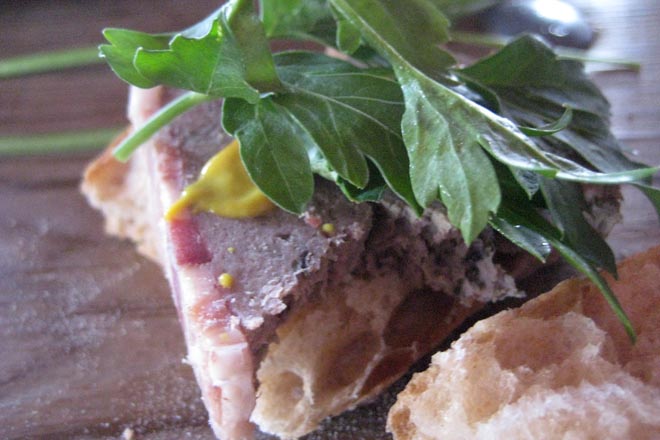
The perfect meal for a sub-zero picnic on the shores of Lake Superior! All you need is good bread and mustard (and cornichons, which the Wedge was also out of). The lamb liver was a pleasant surprise and gave this terrine an appropriately gamy flavor that has been missing from terrines I have made in the past. When dealing with something as high-fat as a terrine, a little gaminess can be a good thing. 

It was too cold to enjoy this

This was my first time using Terrines, Pâtés and Galantines and I was very encouraged by the result, even though I wasn’t able to follow the recipe exactly. I am looking forward to more exploration: especially if I can get my hands on a baby pig…

8 comments | , , , , , ,

Collapsible Baskets by Reisenthel

Collapsible Baskets by Reisenthel

I’ve talked before about trying to do good for the Earth. Maybe “Trashing the Fridge” is a bit extreme, so here’s something you are probably doing already: carrying reusable bags to your localorganicsustainable grocer. I’m big on reusable bags (as mentioned in the above post). Sometimes canvas totes, sometimes IKEA beach bags, sometimes nylon bags that can be squished into tiny sacks so as to fit absolutely anywhere, sometimes just regular paper sacks used again. When I find myself at the grocery  store *without* a reusable bag, I think about those tiny squished nylon pouches and feel a twinge of guilt. Why didn’t I just throw one of those in my bag assuming I’d be buying something somewhere that day?

Guilt-inducing aside, nylon sacks are great, but have you ever felt like a bit of a shoplifter carrying one around and throwing food in instead of using a basket or cart while you’re shopping? Maybe I’m out on a limb on that one, but just the same, handier still are these collapsible baskets. 

They do double duty–basket for shopping, basket for carrying the goods home. They take a little more forethought, true. But I assure you everywhere you go women (and men) will stop you and ask where they can get one too (this post is meant in part as a public service announcement). For those who regularly take the car to do the shopping, just keep them in the trunk!

If budget is not an issue, you can reliably find one at Garnet Hill’s website or through their clothing & home décor themed catalog. If you have a more conservative budget, try a trip to Marshall’s where they’re often available for $9.99. As always, you pay for what you get; the color choices at Garnet Hill are much more varied and so far it seems to be a steadily offered item. Reisenthel, the brand behind the Garnet Hill bags, offers a number of fun patterns as well. I also purchased the covers at Garnet Hill (to go w/ Marshall’s bought bags… bringing the total to $21/ea.).

Color Choices!

And for your monthly (err, weekly) wine shopping, try Reisenthel’s 9-bottle carrier available from reusablebags.com. Trust me, you’ll be the talk of Trader Joe’s with this one.

Bottlebag by Reisenthel

Images: Garnet Hill (top 2), reusablebags.com (bottom)

2 comments | , , , , , , , , , , ,

Happy Valentine’s Day: Butternut Squash Kibbeh

I just LOVE Valentine’s day! What better time to show your sweetie how much you care about them! I spent most of the day decorating the apartment with pink and red crepe paper and singing along to my favorite love songs, but I also took time to make dinner. Earlier in the week I planned to use some small heart-shaped cake pans that we never use to make cupcakes, but as usually happens with my plans to make sweets when the time came around I just didn’t have the heart. But that didn’t mean I couldn’t use the pans:

I THINK IM GOING TO PUKE

Butternut squash kibbeh, from Ana Sortun’s Spice: Flavors of the Eastern Mediterranean, is highly moldable for all your holiday novelty-dish needs. It’s also a great way to use butternut squash in the winter that is (Minneapolis restauranteurs take note) NOT butternut squash ravioli/pasta. For those not familiar, kibbeh is a Levantine/Middle Eastern dish of bulghur wheat mixed with meat (usually lamb) that is eaten raw, baked, or fried. I think it is best fried, but I have never eaten it raw. For this version, butternut squash takes the place of lamb as the principle binder of the bulghur. And while you can’t see it in the picture, this heart is stuffed with spiced feta. I am not a big fan of butternut squash because I think it is too sweet and too smooth-textured, but here the cracked wheat helps with both of those issues by giving the mixture a more grainy texture and diluting the sweetness of the squash.

Here’s the recipe:

Stuffed Butternut Squash Kibbeh

Kibbeh:

  • 3# Squash
  • 4 T beurre noisette
  • 1 onion
  • 1 green bell pepper
  • 1/4 c olive oil
  • 2 t paprika
  • 1 t Middle Eastern five spice
  • 1 1/2 c bulghur or cracked wheat

Filling:

  • 1/2# Feta
  • 1/2 t Middle Eastern five spice
  • 1/2 t sumac (or more – the more sumac the better!)
  • 1/2 t Aleppo pepper
  • 2 T chopped parsley

Roast the squash until it’s soft, then puree it in the food processor until it is smooth and creamy. Season liberally with salt and pepper. Cook the onion and pepper in olive oil until softened and starting to brown, then stir in the paprika and five spice. Cook for a minute. Add the squash puree and warm through. Stir in the bulghur, cover, and turn off the heat. Let sit 15 minutes while the bulghur softens up.

For the filling, mix the (crumbled) feta with all the other ingredients.

To assemble, pack the kibbeh mixture into your desired vessel (for example, a heart-shaped cake pan). Hollow out an indentation and fill it with the feta mixture, then cover with more kibbeh as needed. Bake in 375° oven for 15 minutes. Turn kibbeh out on to a plate (I hope you remembered to grease those vessels, because I sure didn’t remind you!). Garnish with a bit of the feta mixture and maybe some chopped parsley.

We had this with muhammara (it’s red like hearts GET IT?) and pita. Not bad for a Valentine’s day.

Is that a heart-shaped pita?

1 comment | , , , , , , , , , , ,

DIY Sous Vide

You can hardly read anything about food today without running into sous vide. Sous vide, invented by the French, means  “under vacuum” and is a technique for cooking food, especially proteins, in a vacuum-sealed pouch in a water bath kept at a highly specific temperature. This requires both a vacuum sealer and a piece of lab equipment called an immersion circulator, which allows you to maintain a pool of water at a certain temperature with an exacting degree of precision. The effect of all this is to be able to bring meat to its ideal internal temperature: a piece of chicken sitting in 160° water for 4 hours will be 160° internally, externally, and existentially.  It also allows infinitely long cooking times which can produce some textural effects that would not be possible by traditional methods.

The equipment list makes this technique more suitable for expensive restaurants than for the home cook. A search for immersion circulators shows that one can be had for as little as $100 (or much, much more) though I am not sure how precise these would be. Vacuum sealers cost about $30, plus the various supplies. So, it wouldn’t exactly break the bank, but I have a number of items on my to-buy list for the kitchen that I consider higher priorities. And then you have to store it all. Given its high price and novelty, I was pretty quick to dismiss sous vide.

While it was cheapness that turned me away from sous vide, it was cheapness that brought me back to it all of a sudden this weekend. Cheapness in the form of a chuck steak that I bought for less than $5. There are a lot of problems with chuck steak. It can be fatty and gristly, it doesn’t taste all that beefy, and man oh man does it get tough. Chuck meat is mostly used for hamburger or stews, where mechanical stress or long, slow cooking helps break down connective tissue so your teeth don’t have to. But I had a steak sandwich in mind, and for that I wanted red meat damnit! The lowest my oven goes is around 200°F, a temperature that would after even a short time render my steak brown and grey. The challenge was to cook my steak for a long time to weaken the connective tissue without cooking it beyond 120°, rare. The solution: sous vide?

So, did I run out and buy a vacuum sealer and immersion circulator at my local laboratory supply? No! Inspired by this (somewhat annoying) video of Grant Achatz making thanksgiving dinner, I realized that while it would  be nice to have the fancy equipment, the same effect can be achieved with stuff that I had around. Vacuum sealed bags? That’s basically a Zip-Loc, right? And sure, an immersion circulator would keep water at an exact temperature, but I could do pretty well with a thermometer, a pot of water and a gas stove.

Here’s the steak:

RED MEAT

First order of business was to cut out as much fat, cartilage and silverskin as I could, which was quite a lot. It is now sitting in a bag in my freezer, ostensibly for stock or pie but in fact to be thrown out in about a year. Cutting all this out causes the steak to separate into a few pieces, but I was planning on slicing it thin in the end anyway so it wasn’t a problem. I heavily salted and peppered the trimmed steak and threw it in the bag with some butter and then did my best to get all the air out. Then, into the pot of water!

SPLISH SPLASH

When I first put the steak in the water temperature was actually 140°F since I hadn’t been paying attention while attending to the steak. I figured the introduction of the steak would lower the water temperature, but it didn’t by much. I had to add a few ice cubes to get it into the mid 130s. After about ten minutes I had gotten it into my ideal 120 temperature range. Since it was early in the cooking I didn’t think it would matter too much, but in the future I’ll be sure to watch the initial temperature.

I decided arbitrarily to cook the steak for an hour. My technique was basically to check the water temperature every few minutes and keep it between 120 and 125. Eventually, I established a rhythm where I would bring the water up to 125 and then after about ten minutes it would drop back to 119-120. This pattern was very predictable and ended up being very easy to work with. Of course, an immersion circulator would have done all this checking and adjusting for me.

Like bathwater

After the hour passed I took the steak out. As I probed various areas of the steak with my thermapen and got readings all within 120-123 a wide smile broke out on my face–this steak was perfectly rare! The internal temperature was right on. Now to deal with the external appearance.

I don't know if I'd eat that

Obviously, intense direct heat of the kind not afforded by sous vide but rather by more primitive techniques (grilling, for example) does more than just cook the meat through. It also produces a delicious crusty-brown/black exterior that is full of great flavors courtesy of Maillard reactions. Since browning only occurs at higher temperatures, it cannot be achieved through sous vide. So what to do? Well, brown the meat. I used a skillet with smoking hot oil. 

It's brown but could be browner
Actually, I would have liked a much crustier, deeper brown crust, but I was worried that since my steak was already right where I wanted it internally a longer time in the skillet might have overcooked parts. And, whatever you might say about the crust, you can’t argue with this cross-section:

Pretty in Pink

Perfectly pink out to the edges! No ring of grey, overcooked meat! One side is not pinker than the other! It made me wish I had used a better steak!

The whole point of this was, of course, to make it tender. According to Harold McGee connective tissue doesn’t actually start to break down into collagen and gelatin until it reaches 160-180°F. Most of the steak never got above 125°. In spite of this, the steak was notably tender. Cutting out a lot of the gristle before hand certainly helps with this as did slicing the steak very thin before eating it. McGee also offers up another explanation:

“One useful ingredient in long-cooked braises can be a prolonged cooking time–an hour or two–during which the cook carefully manages the meat’s temperature rise up to the simmer. The time that the meat spends below 120°F amounts to a period of accelerated aging that weakens the connective tissue and reduces the time needed at fiber-drying temperatures.” (163)

So does this “accelerated aging” explain the tenderness? The steak certainly would have spent a long time near this temperature, although probably more time slightly above than below. In the future, I should try keeping my water temperature below 120°. This would not only better achieve the aging effect but also allow more leeway for browning in the pan.

Perfectly cooked as this might have been, it was still chuck steak, so I went with a pretty heavy dressing of onions, tomatoes and capers and put the whole thing on ciabatta that I had.

This wasn't even that good. Next time the onions are going in raw, digestion be damned.

In the end you don’t need a lot of fancy equipment to do sous vide (or something like it) as long as you are willing to pay careful attention. That said, I wouldn’t want to watch a pot of warm water for the 6 hours it might take to cook a bigger piece of meat. So I conclude with a word of caution: you can cook sous vide with a pot and a plastic bag, but once you see how perfect that meat looks, you’re going to want an immersion circulator even more.

6 comments | , , , , , , , ,

« Older Entries Newer Entries »