Posts by Tom

The Pleasures of Husmanskost: Rolf’s Kök

Monday, October 10th, 2011

If there is one meal that summarizes most of the eating Martha and I did in Sweden, it would have to be the one we ate at Rolf’s Kök (pronounced “shook”), just north of central Stockholm. No fancy restaurant, Rolf’s was one of many restaurants downtown focusing on husmanskost, everyday Swedish cooking. Husmanskost restaurants generally have a set menu of one or two choices that varies depending on the day of the week (and varies seasonally), as well as a few à la carte items. In our (brief) experience, the two choices were both “meat” (including fish) and “potatoes”. I’ve heard the American Midwest described as a meat and potatoes culture, but the Swedes take this to a whole new level.

Rolf's Kök patio seating and menu

We went to Rolf’s Kök on a Monday in late August, giving us the choice between “Lukewarm Poached Salmon with Cucumber, Fennel and Dill Mayonnaise” or “Isterband (Fermented Lard Sausage — post forthcoming), Mustard Creamed Potatoes and Beetroot”, preceded in either case by a bowl of Cauliflower Soup. I ordered the salmon, Martha the isterband.

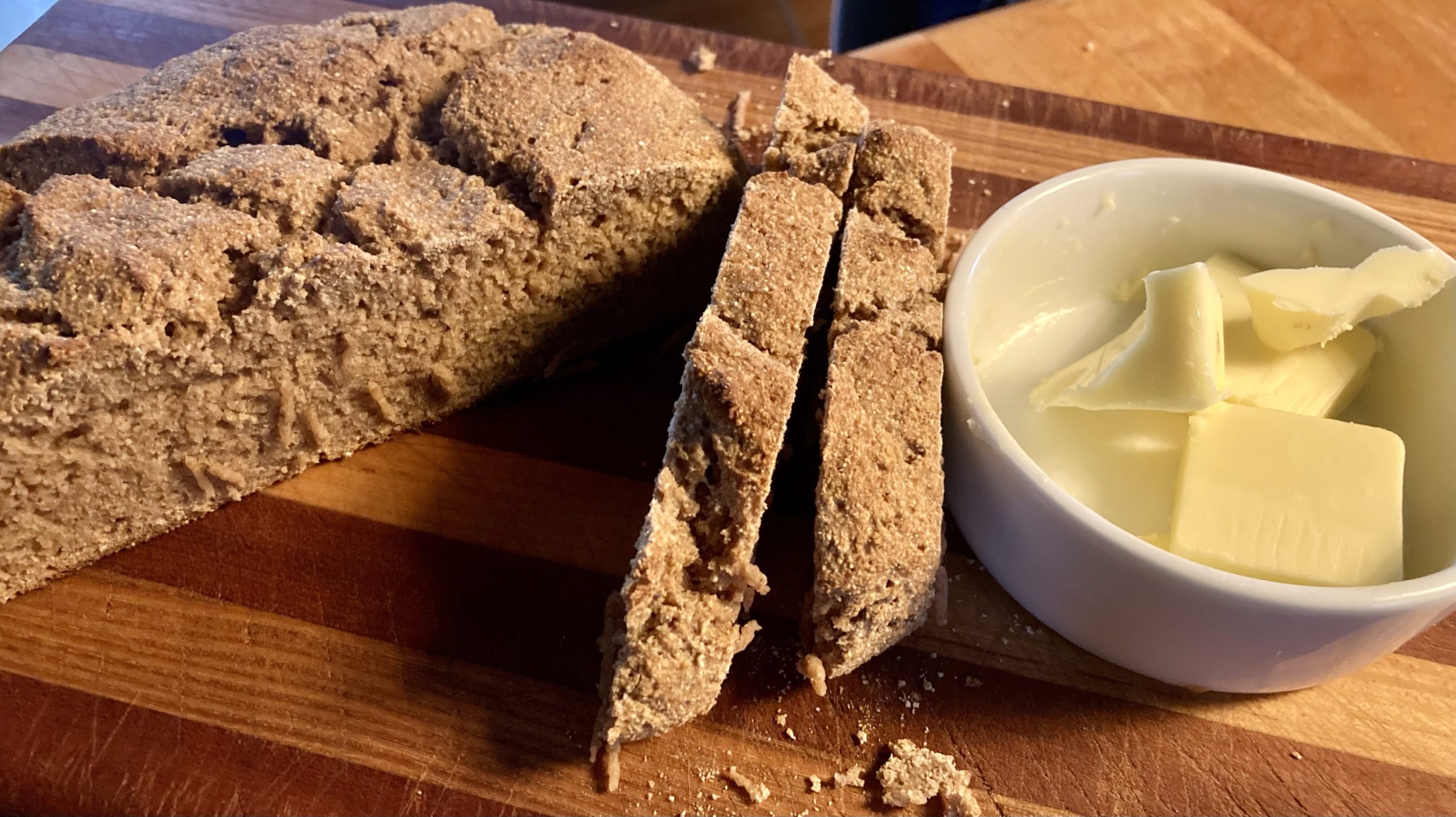
bread and butter at Rolf's Kök

After our menus were taken away our server delivered a tower of crisp rolls of bread impaled on a spike. I’m pretty sure this arrangement would have been met with many a personal injury lawsuit if it were attempted in the U.S.A., but Sweden is a less litigious place and anyway Martha and I somehow managed to remove our rolls without receiving the stigmata. The bread was accompanied by twin whipped butters and a third container full of tiny ziggurats of sea salt.

bread + soup at Rolf's Kök

The rolls looked so good that they practically demanded to be eaten right away, but Martha and I somehow managed to resist long enough for the cauliflower soup to come to the table — a good thing, too, since bread was the perfect implement to sop up every last bite of cauliflower cream. Europeans have a better developed art of vegetable purée than we do in the United States. Give a European a vegetable — just about any vegetable — and they’ll serve it back to you as a creamy-textured soup that tastes like the vegetable in question, but with subtle flavors that suggest greater artifice than simply tossing cream, broth and cauliflower into a blender.

I’ve said that our meal at Rolf’s was a typical example of the kind of food we were eating in Sweden, and indeed salmon with potatoes and dill mayonnaise is something you can get just about any-where and time) throughout the country. But to call the salmon brought to me at Rolf’s Kök average really doesn’t give the restaurant enough credit: this was a really exceptional example of the Swedish favorite. Lukewarm (exactly the word our waitress used to describe the dish in her impeccable English) is not a word that carries positive connotations for me, especially when used to describe food, but it was just right for this fish — you can’t really taste anything when it’s piping hot.

salmon at Rolf's Kök

The sausage Martha ordered was described as ‘tangy’ which indeed it was. At the time we assumed this was from lemon zest or some acidic ingredient but later found out that the tangy sourness of isterband  is caused by Lactobacillus, active during the four or more days when the sausage is aged at just below room temperature. Isterband is not cured; it is moist like a fresh sausage. It’s just not quite fresh. This was one of the most interesting things we ate in Sweden.

sausage at Rolf's Kök

That’s how it was with Rolf’s Kök: typical but especially well-executed Swedish food. The restaurant also stood out for us in a way unrelated to the food: this meal was the first time, after three days in Stockholm dining out twice per day, that we experienced real table service, where our order was actually taken while we were sitting at a table, looking at a menu book. Up to that point, the norm had been counter ordering, with our food either picked up at a central point our brought out by a server announcing the name in inscrutable-to-us Swedish or, better, our order number, which our two semesters of Swedish classes at the American Swedish Institute a few years ago barely allowed us to parse. Of course, the level of service we encountered  might have had something to do with the types of restaurants we were eating at — Martha and I try to be frugal within reason when traveling. But it’s not like we were eating exclusively at coffee shops, which is about the only place, in Minneapolis at least, where you have to put up with counter based ordering. It seemed to be a cultural preference for the Swedes, and it makes sense from an efficiency standpoint: one central place to post the menu, take the orders, handle the cash. But I always feel a little on the spot when ordering at a counter: trying to read a giant chalkboard menu, a line of hungry and decided diners behind me — and being next-to-clueless about the language the menu is written in only exacerbates my anxiety issues. In light of this and the other stresses of travel, being seated and handed a menu at Rolf’s Kök was a relief.

And it’s not like we had to pay a premium for the convenience, either. The prices at Rolf’s were comparable to the other places we had been dining. Our lunch cost 274 Swedish crowns, which the good people at Visa tell me is $47.51. This seems like a lot, but it was pretty hard to find a meal in Stockholm that cost much less. If they could all have been as good as Rolf’s Kök, we would have been well pleased.

This Guy Likes Pig’s Eye

Tuesday, September 20th, 2011

It’s no secret to regular readers of this blog, or regular readers from the summer of 2009 at least, that I get pretty excited about going to the farmers market, especially Minneapolis’s Midtown Farmers Market. When asparagus, tomatoes, or sweet corn show up on vendors’ tables that excitement is easy enough to understand, but I’m just as jazzed by the availability of local cabbage and potatoes (the appearance of winter squash, however, continues to fill me with a sense of deep dread). That said, I do appreciate it when a vendor takes a risk on some produce that’s outside the market norm, and for that reason a new vendor — Pig’s Eye Urban Farm — has been winning my heart all summer.

It all started back in May, when I go to the market not expecting to find much more than a cup of coffee. At the Pig’s Eye stall there were green things! Garlic Mustard Greens, to be precise. Unlike the herbs and rhubarb also sold that day, these greens had not been intentionally cultivated: they were found growing on several of the lots that make up Pig’s Eye. I’m a sucker for wild foods, so of course I went home with a bag. The greens were a little tough raw in a salad (with garlic and mustard, of course), but they were perfect after a brief saute.

As the growing season went on, Pig’s Eye kept throwing me culinary curveballs. Locavores in Minnesota get used to finding new ways to appreciate the radish as it is one of the only vegetables available in the early days of summer, but Pig’s Eye took my appreciation to a much deeper level by introducing parts of the radish plant I hadn’t considered: first it was radish seed pods, the pods that develop when radishes are allowed to go to seed. Radish seed pods look like miniature snap peas and have a pretty pea-like flavor: bright green grass followed by the hint of radish tang, and increasing radish heat as you eat more and more. I loved them raw, and they worked well in a stir-fry too. Also stir-fryable were radish blossoms, delicate white flowers. The flavor was similar to the seed pods, green with a hint of radish. And of course, Pig’s Eye was selling radishes, and even had spicy ones, which are more or less unheard of these days.

I’ve appreciated the way Pig’s Eye kept me guessing all season, and also their more traditional offerings: their kale caught Rick Nelson’s attention, and they’ve had fine multicolored beets, heirloom tomatoes, and the other seasonal goodies one expects throughout the summer. Last weekend, though, I got the best surprise of all: there, front and center at the Pig’s Eye table, was a basket overflowing with bright green cones of hops. Cascade hops, to be precise. This was totally unexpected — I have never seen hops at the farmers market before, and it was my understanding that those in search of fresh hops either had to grow their own or make special orders from the Pacific Northwest. To be able to pick them up at the farmers market — what exciting times we live in!

What can you make with hops? You can pickle them — I once had a burger with pickled hops on it, though the memory is not a pleasant one. According to Nathan, the Pig’s Eye proprietor, hops make for an interesting tea. Or you can go the obvious route: make beer. That’s what I did: after a quick ride out to Midwest Supplies for, uh, supplies, I spent the rest of the afternoon brewing away in the kitchen and taking in that fresh hop aroma.

Bitter Melon, Bitter Tears

Thursday, August 11th, 2011

I’m sorry, bitter melon, but I don’t think it’s going to work out between us. No, hush, just listen.

I remember when I first saw you at the farmers market. You were so different from all the other vegetables, all rough around the edges. I admit I was afraid to approach you, and I had a real thing going for zucchini at the time, so I just let you be. But I couldn’t get you out of my head. Finally, after reading about your virtues in Cooking from the Heart: The Hmong Kitchen in America, I screwed up the courage to talk to you.

cross section of a bitter melon with red seeds insideThings were going so well when I first brought you home. Remember how lovingly I cleaned your every crease and crevasse with a mushroom brush? You didn’t even complain when, in my youthful inexperience, I cut you in half lengthwise, when we both know you deserve to be cut in half crosswise. And then to look at your seeds. Oh, your seeds. So large, so bright red, your seeds were just screaming of your readiness, your ripeness. As I lovingly filled you with a mixture of pork, onions and cilantro and set you to simmer nice and slow, our future together seemed — and smelled — so bright.

No, don’t cry. Look: it’s not about you, it’s me. I was raised in the American Midwest on two flavors: sweet and salty. Have you tasted our ketchup? Nothing in my culture, my upbringing prepared me for a bitter flavor like yours. So, so bitter. You were like nothing I’ve ever tasted before, and you deserve to be with someone who will really appreciate you.

Maybe if I just didn’t try to consume so much of you at one time, if I chopped you into a salad, if I used you as an accented flavor rather than the main part of the dish, maybe then… No — you’re right. No sense in fooling ourselves. It’s over. Goodbye, bitter melon.


Summer Vegetable Stew — Not (Quite) Ratatouille

Monday, August 8th, 2011

To paraphrase Sara Bareilles, I’m not gonna write you a ratatouille recipe. (I promise that will be the last Sara Bareilles reference — ever — on this blog.) I’ve done it before, and with farmers markets overflowing with more zucchini and eggplant than a blogger knows what to do with, you can be sure you’ll be seeing a big crop of ratatouille posts on your favorite food blogs in the next week or so. I figure once Disney takes on a topic, there’s really nothing more I can add.

summer vegetable stew in a yellow pot

Not that the attention ratatouille garners is undeserved; packed with vegetables at the height of summer ripeness, it is one of the best testaments available to the joy of eating seasonally. In fact there may be no better way to enjoy zucchini, eggplant, bell peppers, onions and tomatoes all at the same time. But the real lesson of ratatouille lies not in the adherence to those core ingredients but in the happy combination of peak season produce, with nothing that’s not in season. Just about any combination will do, as long as the vegetables are fresh and ripe.

Luckily, this is the time of summer when the overabundance in farmers markets helps keep my kitchen stocked with nothing but fresh, ripe vegetables. The motivation for this summer stew was two large eggplants, but as I stooped down to remove these from the crisper drawer I kept seeing additional prospects for a seasonal stew: half a head of cabbage, a green pepper, five small leeks, tomatoes (the latter not, of course, stored in the refrigerator).

The great thing about a stew is you can be pretty lax about procedure since it’s all getting cooked together anyway. I cubed and salted my eggplant, since conventional wisdom suggests doing so will remove some kind of bitterness. I then sauteed sliced leeks and green bell pepper in a large amount of olive oil until the leeks were starting to brown deeply. I added the eggplant cubes and let them brown a bit too. Next went in the half head of cabbage, thinly sliced, a large sprig of thyme, and about ten roma tomatoes that I had pureed (and salted and sugared to make up for really lackluster flavor — you don’t win ‘em all at the farmers market). I added water to just about cover everything and let the pot stew away for a half an hour while I cooked some white rice. Right before serving the dish, I sprinkled it with fragrant basil shreds.

I was happy with the way this turned out, but I hope I don’t have you headed to the store in search of two eggplants, a half head of cabbage, a green pepper, five leeks and ten roma tomatoes because the point of all this was that if the ingredients for your summertime stew are fresh and in season, you won’t go wrong — it’s the spirit, not the letter, 0f a ratatouille recipe.

Reluctantly Fried Zucchini Blossoms

Thursday, July 28th, 2011

I buy zucchini blossoms exactly once per year, and not because I want to. Sure, they look pretty, and I love the concept of fried zucchini blossoms — crisp and airy, redolent of fields of flowers — but I’ve never been able to deliver on that idea. Instead of light and crunchy my fiori come out oiled and heavy and I vow each year not to bother with them again. But there comes a time each summer when Martha, thinking wistfully of a summer abroad in Italy, insists that we buy a bunch and that I try to cook them.

fried zucchini flower

I am confident to cook most of my farmers market haul without consulting references, but zucchini blossoms send me into panic mode and I dive deep into whatever my miscellaneous Italian cookbooks and the Internet have to tell me. In past years this has yielded up some interesting, if ultimately flawed, techniques. Patricia Wells’s Trattoria recommends making a meringue of a batter with three egg whites (along with flour, water and beer) which makes a nice fluffy coating. Nice and fluffy, that is, until the meringue produced after furious whisking starts to droop, and the battered blossoms with it. Even the first few flowers when the meringue was working were coated in a great puff of a shell that drew most of the attention to itself. I don’t remember on what website I found the recipe for the disaster of the year before that (I think club soda was involved) but if it had been any good, I would have saved it.

With two consecutive years of failure under my belt, I was determined as ever not to buy zucchini blossoms this year. I put up a pretty good fight, having delayed the purchase until late July before Martha finally got her way and we went home with a bundle of bright orange blossoms in our basket. Unsuccessful in my attempt to avoid them altogether, I was at least determined not to repeat the mistakes of the previous years, and by my calculation principal among them was reliance on dubious and finicky recipes. So I scrapped the recipes and went with what I knew in my heart to be true: when it comes to frying vegetables or anything else, you can’t go wrong with beer batter. Mine was made with half a bottle of my home-brewed Irish red ale and enough flour to achieve a thin consistency that was still substantial enough to fully coat the flowers.

It just goes to show you, to paraphrase a wiser man than myself, beer really is the solution to all of life’s problems. These fried blossoms were just what I was after: the batter was crisp but still delicate enough that you could tell you were eating a flower. Light salting after they came out of the oil was all the needed seasoning.

cross section of a fried zucchini flower

If you have the option, buy zucchini blossoms with long stems. These impart two advantages: the stem serves as a handle allowing you to swirl the flower fully in batter without getting your hand dirty, and this handle also affords you a method for lowering the blossoms into 350°F vegetable oil without burning off your fingerprints. It’s a real win-win.

While I’ve faced substantial doubt in the past about what to fry zucchini blossoms in, there’s never been any question what to dip them in once they are fried. I make aioli (whisk together a mashed clove of garlic, an egg yolk, citrus juice, salt, pepper and a little mustard then slowly whisk in about 3/4 of a cup of oil) thinned by using a higher proportion of lime or lemon juice — the thinness of the sauce is important as the delicate flowers won’t stand up to being dragged through a thick mayo.